

Disease description:
- Also known as ‘red rust disease’
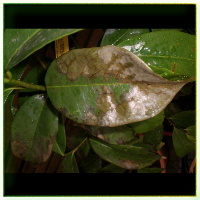
- Caused by parasitic green alga, Cephaleuros virescens Kunze, of the family Trentepohliaceae, under the division Chlorophyta
- Direct relationship between reduced tree vigour and damage caused by the alga
- Initial small areas of yellow-green to grey growth on the upper surface of leaves
- Later a ‘velvety’ texture due to the formation of sterile hairs (setae) and sporangiophores which contain the pigment haematochrome that give the colony a rusty-red colour
- Algal spots on Fuerte avocado leafs are the typical rusty-red colour
- If algal growth is extensive it can reduce the photosynthetic potential of the leaf
- Click here to read more
Disease Description:
- Caused by Colletotrichum gloeosporioides
- A reason for major fruit quality problems on the market
- Usually infection accurs when fruit was damaged by sucking bugs or wind
Symptoms:
- Large round brown secondary infection spots in fruit or smaller tear-drop shape spots on fruit skin
- Postharvest fruit decay
Control Options:
Prevention:
- The Velvick rootstock shows increased resistance to anthracnose on fruit
- Use windbreaks in windy areas to reduce fruit scarring and reduce penetration points for fungi
- Prune out dead wood before flowering to reduce wind damage and remove spores from the tree
- Pruning increases ventilation which reduces dampness and humidity in the tree that would promote fungal growth
- Control pests that damage fruit
- Keep calcium and nitrogen in balance as this improves fruit resistance to anthracnose
- Do not harvest in wet conditions as this makes fruit sensitive to mechanical abrasion which will predispose fruit to infection
- Treat fruit within 24 hours of harvesting with a registered postharvest fungicide

Pest description:
Avocado scale – Fiorinia fioriniae (Targioni-Tozzetti)
- Found on many different host plants in the world
- Feeding damage occurs on the fruit and leaves, and is caused by the immature stages that are light brown in colour
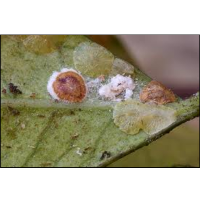
- Female avocado scales have a transparent exoskeleton, are orange-brown in colour and 1.0 – 1.3 mm in length
- Immature males have a white exoskeleton and are elongate-oval in shape
- Very little research has been done to date on the biology and control of avocado scale in South Africa
- In other parts of the world, 3 – 4 generations have been monitored per year in avocado orchards
Heart-shaped scale – Protopulvinaria pyriformis (Cockerell)
- One of the most damaging scales on avocado leaves
- No damage is not done to the fruit
- The protective layer (± 3 mm wide) of the female heart-shaped scale is hard, brown and heart-shaped with dark radial stripes
- A waxy egg-sack is often visible under the female scales with 200 – 300 eggs per sack
- The male form of the scale has not been seen in South Africa
- Two generations of heart-shaped scale can be monitored throughout the avocado season in the Nelspruit area.
- Nymphs or crawlers are light green
- They emerge from eggs during November and March
- It takes roughly 5 – 7 months from egg to adult stage, depending on temperature
Deficiency Symptoms
- Fruit small and misshapen, bumpy and sickle-shaped, overcoming B deficiency in ‘Hass’ shown to increase fruit size by 13-18% but no effect on number of fruit or total yield per tree (Smith 2004).
- Fruit to stem joint is skew and twisted
- Abortion of fruit
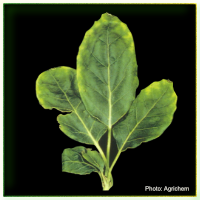
- Chlorosis of leaf tips and margins in young leaves, leaves distorted and crinkled
- Death of young buds and new growing shoots (apical and axillary growing points)
- Shoot tip death result in knob on shoot
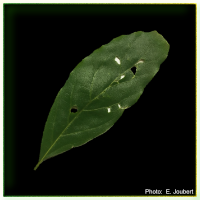
- Typical shot-hole symptoms on spring flush leaves, and yellowing of young leaf edges.
- Swelling of twigs, node swelling, corky lesions, trunk canker, limb dieback
- Loss of apical dominance resulting in horizontal rather than vertical growth
- High B concentrations in ‘Hass’ fruit flesh correlated with lower incidence and severity of diffuse flesh discolouration and vascular browning, and lower severity of body rots (Marques et al. 2003)
Cause of deficiency:
- Light, sandy soil
- Too much N
- Too much Ca
- Cold / wet weather
- Low soil moisture (drought)
Deficiency Symptoms
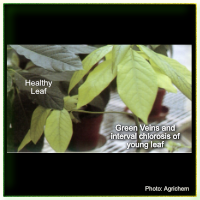
- Chlorosis (yellowing or in worst cases bleached white) of areas between leaf veins while veins and midrib remain green
- Brown necrotic areas develop on leaf
- Stunted or thinned extension growth
Cause of deficiency & symptoms:
- Chlorosis (yellowing or in worst cases bleached white) of areas between leaf veins while veins and midrib remain green
- Brown necrotic areas develop on leaf
- Stunted or thinned extension growthCauses:
- Excessive Zn depresses Fe uptake
- Calcareous or limestone type soils with a high soil pH
- Applications of calcium carbonate (lime) can cause lime induced chlorosis
- High levels of B, Cu or Mn
- High P levels reduce the solubility of Fe
- N accentuates Fe deficiency due to increased growth of tissue
- Poor drainage or excessive rain
- Sandy soils
- Peat / muck soils where organic matter ties up iron

Deficiency Symptoms
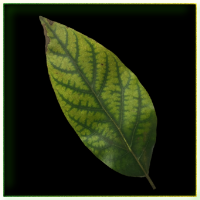
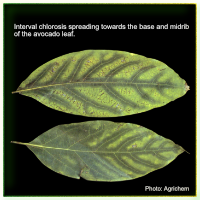
- Older leaves develop interveinal chlorosis
- Yellow colour moves from tip of leaf toward the midrib of leaf, base of leaf remains green
- Low Mg levels correlate with high grey pulp incidence in Fuerte.
Cause of deficiency:
- Acidic soils (low pH): In acidic soils, Al competes with Mg for root uptake sites
- Sandy, lightly structured soil: There is high K content in these soil
- Some cultivars / rootstocks show poor Mg uptake
- Wet, cool weather
- Uptake affected in decreasing order by the presence of K, ammonium, Ca & Na
Deficiency Symptoms
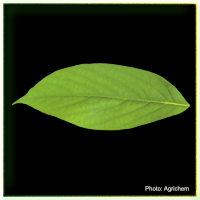
- Young mature leaf develops dull, yellow mottled appearance (interveinal chlorosis), first near midrib and then extended to outer leaf edge
- Leaf size and shape remain normal
Cause of deficiency:
- Too much Mn is more of a problem than too littleIncrease the soil pH to decrease Mn uptake
- Like Ca and Mg, the uptake of this cation is competitive
- Relatively immobile in plants
- Translocated via xylem as Mn2+ or weakly combined with organic acids
- Concentrates in growth points (meristematic tissue)
- Too much Mn will result in interveinal chlorosis with small reddish-brown spots, small black spots developing next to the leaf midrib and larger veins, and rooting in cuttings may be impaired

Deficiency Symptoms
- Few fruit produced, fruit are small
- Older leaves turn pale green to yellow first
- Veins lighter in colour (yellow) than the rest of the leaf
- Leaf abscission and small leaves produced
- Affected leaf edges may roll up
- Severe deficiency tip burn and leaf fall may occur
- High N levels and low Ca levels result in grey pulp occurrence in Pinkerton
Cause of deficiency:
- Sandy, lightly structured soil
- Extremes of pH
- Poor levels of organic matter
- High rainfall or heavy irrigation (leaching)
- Large quantity of crop residue, need N to decompose
- Crops with rapid growth habit
- A deficiency of Mo will decrease N use because enzyme nitrate reductase is dependent on Mo
- Mg will synthesise proteins and metabolize P and N

Deficiency Symptoms
- Stunted growth
- Small leaves and leaf abscission
- Bronze colour in new growth
- Bronzing has been observed on Lamb Hass and the deficiency was plausibly rectified with a foliar application of MAP
- Branch dieback
Cause of deficiency:
- Extremes in soil pH
- Low organic matter
- Plants with poor root structures
- P retentive soils
- High Fe content in soil
- Cool, wet weather
- Low B levels reduce the ability of P to transfer energy in the plant and may halve the capacity of the plant to absorb P
- Low Zn levels result in unregulated P uptake, may cause excessive / toxic levels of P (similar visual symptoms as Zn deficiency)
- Al combines with P in the intercellular areas of the root tips and decreases P translocation of P into the plant and induces deficiency symptoms
- Nitrate depresses the uptake of anions such as Phosphate
- Mg will help with synthesis of proteins and metabolism of P and N
Deficiency Symptoms
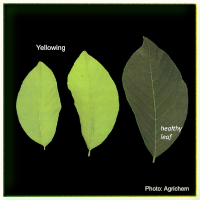
- Chlorosis and smaller leaves produced
- More symptomatic on younger leaves
Cause of deficiency:
- Acidic soils (low pH)
- Sandy, light poorly structured soil
- Low levels of organic matter
- Waterlogged soils
- Dense, poorly aerated soils
Disease description:
- Avocado Sunblotch Viroid (ASBV) is transmitted through seed, grafting, pollen transfer & via pruning
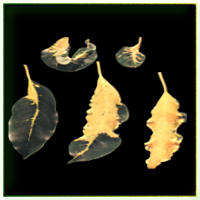
- Leaves show distinctive white, pink or yellow streaks or mottles and can be distorted
- Branches show yellow, orange, white or colourless sunken streaking and spotting of the bark
- Fruit develop sunken yellow or reddish streaks on the skin, generally extending from the stem end
- Fruit may be small and distorted
- Infected trees suffer from canopy loss and flower excessively.
- Infected trees set fruit later than uninfected trees, and have a lower yield.
- Fruit from infected trees ripens faster, colours quicker, is more susceptible to vascular browning and rot, and softens quicker than fruit from uninfected trees.
Deficiency Symptoms
- Yellow strip along side-ribs (tram tracking) while midrib and base remain green
- New leaves are small and curled
- Short internodes leading to ‘rosetting’, also caused by reduced leaf and shoot growth also producing a “feather duster” appearance
- Round fruit, occasionally reddish
- Leaf mottling between veins
- May be more evident in spring as soils are too cold for uptake (Newett et al. 2018)
Cause of deficiency:
- Alkaline soils (high pH)
- High levels of organic matter
- High levels of phosphorous in the soil
- Cool, wet weather conditions