


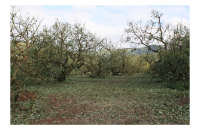
Damage
- Damaged bark exposes the vulnerable tissue below to external pathogens:
- Fungal infections such as Cercospora spot infection on leaves and stems in humid seasons.
- Phytophthora stem cankers
- Bacterial canker (caused by Pseudomonas syringae)
- Extensive bark damage on branches causes physiological problems:
- Damaged branches have slower growth rate than healthy shoots
- Regrowth of new healthy shoots are suppressed through apical dominance of damaged shoots.
- Damaged branches produce sparse foliage that provide poor shading
- Fruits growing from damaged branches tends to be smaller and at greater risk to sun burn damage
- Defoliation put trees at risk of sunburn. Branches and trunk are exposed to direct solar radiation that cause localised temperature extremes.
- This problem is aggravated by transpiration losses: Water transpiration occurring from leaves causes an evaporative cooling effect. Defoliation compromise the tree’s ability to transpire and keep itself cool.
Case Study
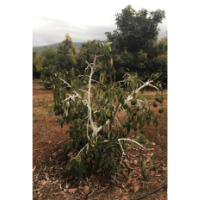
Following an extremely destructive summer-hailstorm in Letaba on 4 February 2016 that stripped trees down to the bark, these actions proved highly effective for restoring production:
- “Stag-horn” branches to best possible healthy wood above root stock union.
- After stag-horning, stumps were sprayed with alliette at 40g/knapsack.
- Trees were painted with PVA and Nordox at 30g/20L.
- No growth regulators were used.
- Manual hand pruning done over 18 months to restore tree shape and remove damaged branches that was passed over before. It is essential to prune back hard enough so that no damaged material remains.
- No fertilizer was applied 1st 6 months, from August onwards monthly applications.
- No irrigation over autumn or winter, short irrigation sessions from July onwards.
Recommendations
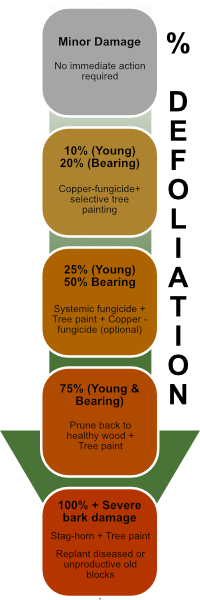
- Appropriate level of intervention will be determined by tree age, season and severity of hail-damage:
Disease description:
- Phytophthora root rot is one of the major problems in avocado production in many regions of the world, including South Africa
- In South Africa, high summer rainfalls and warm temperatures contribute to the incidence of root rot caused by Phytophthora cinnamomi
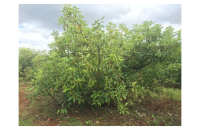
- First symptoms observed are die-back of feeder roots, which induces a number of stresses on the plants, resulting in defoliation, die-back of branches and occasional death of the trees
- Yield of marketable fruit is severely affected
- Control measures include maintaining soil health and phosphonate fungicides which release phosphorous acid that controls the disease.
Control options:
- MRLs

Disease description:
- Rosellinia necatrix Berl. ex Prill. is a soil-borne saprophyte and grows at temperatures between 5-30°C and a soil pH between 6-8
- This ascomycete fungus produces toxins that are involved in the death of the tree. The fungus can survive in the soil by producing thick-walled spores (chlamydospores)
- Causal agent of white root rot disease on a wide range of plant species
- Symptoms resemble Phytophthora root rot
- Primary symptoms include rapid decline of vigour, sparse foliage and leaf wilting
- Secondary symptoms occur quickly (2 weeks) and include chlorosis, leaf drop and death of the entire tree, often with fruit still attached
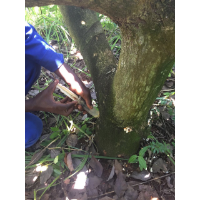
- Dark brown lesions are present at the base of the trunk with white mycelial gowth on the bark and mycelial strands occasionally extending under the bark
- Infected roots become necrotic and covered with a fine layer of mycelia
Control options:
- Control options are limited as no fungicides have been efficient in controlling the disease
- Fluazinam has shown potential in controlling white root rot and is registered in Australia on apples.
- An integrated approach of biocontrol, solarization and good orchard sanitation has shown promising results in other countries
- Orchard sanitation should focus on immediately removing infected material and restricting vehicle movement in the orchard until the disease has been identified
- Solarization and good soil preparation prior to planting is critical
- Magagula et al. (2021) have recommended pre-planting fumigation with chloropicrin (trade name: Pic Plus), followed by application of B-Rus and Trichoderma harzianum T22 (trade name: Trianum-P) during planting and replenishing when necessary. For an established orchard, apply fluazinam in combination with B-Rus and Trichoderma harzianum T22. Note that fluazinam is not registered on South African avocados, but applications for formulations are with the Registrar.
What to look for:



Photos provided by: Noëlani van den Berg, Avocado Research Programme (FABI), University of Pretoria
More information:
Sample submission
Send samples to the following address:
Attention: Dr. Lieschen De Vos
FABI Diagnostic Clinic
FABI
University of Pretoria
Lunnon Road
Hillcrest
Pretoria, 0083
Tel: 012 420 3938, 012 420 5826
Email: diagnostic.clinic@fabi.up.ac.za
Please download, fill in and include relevant details in the sample submission form