Pruning

Why do we prune avocado trees?
This is the most basic reason for pruning. When we plant trees, we have already decided what space the tree will take up i.e. what its maximum dimensions will be. When the orchard reaches maturity (every tree has filled its allocated dimensions), we need to find an effective way to restrict/constrain it.
To keep a mature tree to size, we need to remove the same percentage that has grown during the season e.g. if the tree grows 20% bigger during the season then we have to remove 20% just to keep it to size. However, never remove more than 25% of the total tree volume – excessive pruning will result in excessive flushing and a vegetative state, reducing yields.
Bear in mind that the type of cultivar influences what the tree shape should be. For example, Fuerte is a vigorous, spreading tree and so will lend itself to an open vase tree shape whereas Maluma has a strong central leader.
Areas of a tree that do not receive enough sunlight, will slow down in growth and the branches will eventually die.
When an orchard gets crowded, the trees will allocate all their energy towards growth in order to stay ahead of the competition. This will lead to a situation where all the growth takes place in the top part of the tree which receives the most sunlight.
To change this situation, make sure the tree will get enough sunlight all around so that it does not compete with its neighbours. Pruning is the only way that we can make sure that the tree gets enough sunlight all around. Remove branches that overshadow those that you want production on. Start from the top of the tree and prune so as to create windows. Thin out and tip any regrowth at these open windows, but leave 2-3 shoots after a large cut to ensure soft growth and tip these to break apical dominance.
Ensure that you paint exposed branches after pruning to avoid sunburn damage.
This is a very exciting part of pruning. Pruning must be done so as to keep the bearing branches young. If we keep on removing the outer part of the tree, the inside branches will become old and very thick. This will lead to the death of the inner branches. To prevent this happening, older branches need to be removed to make way for new branches.
When we start with pruning, all three of these points must be addressed simultaneously. This means that when we make a big cut it must address all three points, namely
- To keep the tree in its allocated space/dimensions,
- To bring in sunlight to the right areas, and
- To rejuvenate the tree.
To achieve this, the shape of the tree is very important. If we leave more than one central leader, it will force the tree to grow wider as it grows higher. This will lead to the overshadowing of the lower branches, and we cannot afford that to happen.
Pruning can also help mitigate alternate bearing. Prune more heavily in an on-year, as this will thin out fruit that will drain a tree’s reserves in maturing that fruit.
How to Prune
Timing:
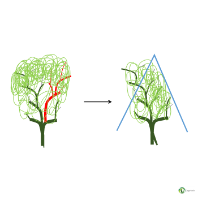
Make big cuts as soon as possible after harvest (complete within one week after harvest) so that new growth can support the future crop. For orchards harvested later in the season (August-October), prune once flowering has begun.
For orchards harvested earlier in the season, do follow-up pruning between October-February.
Type of cuts:
The cuts must be located between 1.5 and 3m from the soil surface. If the cuts are too high, the tree will be difficult to manage and this will not bring enough sunlight into the tree. The cuts must be big and deep enough to last for the whole season. If a cut is too small and too shallow, it will close up after the first flush.
Equipment:
This cuts must preferably be done with a hand saw. Importantly the saw must not be too big. Use only sharp saws. if the saw is blunt, the operator will take longer to cut. You can also use pole pruners for tall branches.
The aim of this pruning:
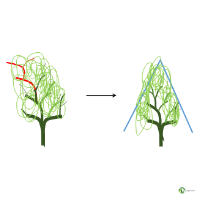
This part of pruning is to trim the skirt, width and height of the tree. The main aim is to keep the work rows open and to restrict the height of the tree. Keep tree height to 75% of the working row width, and trim branches to 1m away from where a vehicle tyre would be.
Timing:
This can be done till about November.
Type of cuts:
The cuts to restrict the height can sometimes be big.
Equipment:
The height is controlled with extension saws or with automated pole pruners. The cuts to the side of the road can be done with hand saws or loppers. The skirting is normally dune with pruning scissors.
The aim of this action:
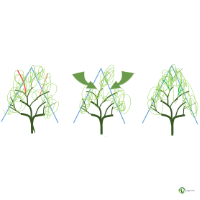
Is to come back and clean the deep cuts that have been made after harvest from any water shoot growth. If you do it too early it will just grow again, but it is very important to do it.
Timing:
This is normally done during February and March.
Type of cuts:
Mainly the removal of watershoots coming from the cuts made.
Equipment:
Normally these shoots can be removed by hand.
Advantage of Correct Pruning
Sunlight is one of the most important inputs in production and, with the correct pruning, the tree will have more active bearing areas receiving enough sun.
After pruning, the tree is more open and height restricted which will contribute to more effective spraying.
Harvesting and stripping of the trees is easier because the height is restricted and more yield on the lower branches is promoted.
Correct pruning will rejuvenate the tree continuously, thus preventing the tree from developing an old and unproductive framework.